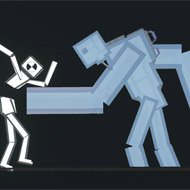
People Playground looks like a physics toy at first glance, but it plays like an open-ended lab where every tool interacts with every object in ways the game never explicitly teaches you.
| Genre |
Physics Sandbox |
| Main Focus |
Experimentation |
| Core Tools |
Ragdolls, Weapons, Materials |
| Platform |
Browser |
Learning the Ragdoll Physics Engine
The first few minutes of People Playground are usually spent dropping a ragdoll from a height just to see how the joints react. Every limb responds independently to gravity and force, which means the same fall can look completely different twice depending on how a character lands.
This physics-first design is the entire foundation of the game. Nothing about movement or damage is scripted in a fixed way; it emerges from how objects, weights, and forces interact in the moment, which is exactly why the sandbox holds attention far longer than a simple ragdoll toy would.
New players often skip past the settings menu, missing that gravity itself can be adjusted, along with friction and other variables that change how every later experiment behaves.
Weapons, Explosions, and Chain Reactions
People Playground’s weapon roster covers everything from basic melee tools to firearms and explosives, and each one applies force differently. A blunt weapon transfers momentum in a way a bullet never will, and understanding that difference is what separates a random mess from a deliberately staged scene.
Explosives introduce a layer most players underestimate: blast radius interacts with nearby objects, meaning a single detonation can trigger a chain of secondary reactions if flammable or fragile materials sit close enough together.
- Combine blunt and explosive forces to see how a ragdoll’s joints separate under compound stress.
- Use environmental props as makeshift barriers to test how explosions redirect around solid objects.
- Layer multiple ragdolls to observe how force transfers from one body into the next.
Building Deliberate Setups Instead of Random Chaos
The players who get the most out of People Playground treat it like a puzzle in reverse: instead of solving a challenge, they design one. A common approach is building a Rube Goldberg-style chain where one triggered object sets off the next in sequence.
This kind of setup takes patience that the sandbox doesn’t reward on the first attempt. Getting a multi-step chain reaction to fire correctly usually takes several failed tries, since even small physics variations can break a sequence that worked a moment earlier.
Community discussion around the game tends to focus heavily on sharing these constructed scenes, since a well-built chain reaction is far more interesting to watch than an unplanned explosion, even though both use the exact same tools.
What the Sandbox Doesn’t Tell You
There’s no objective in People Playground, and that absence of direction is something new players occasionally find disorienting rather than freeing. The game trusts you to invent your own goals, which works well for players who enjoy open experimentation and less well for players expecting structured progression.
One detail only playing reveals: material properties genuinely differ under stress in ways screenshots can’t communicate, since a fragile object shattering mid-experiment carries a different rhythm and timing than a blunt one simply toppling over.
Common Questions About People Playground
Why does the same experiment produce different results each time?
The physics engine calculates force and joint reactions live rather than following a scripted animation, so small differences in timing or object position change the outcome even when the setup looks identical.
Do I need a specific goal to enjoy the game?
No, but players who set their own small challenges, like building a working chain reaction, tend to get more replay value out of the sandbox than those who only trigger a single explosion and move on.
Is there a difficulty curve at all?
Not in the traditional sense; the challenge in People Playground is self-imposed, and the only thing that increases in complexity is whatever setup you decide to attempt next.
People Playground never tells you what to build, and that’s precisely why the same ragdoll and the same handful of tools can produce a completely different session every single time you open it.