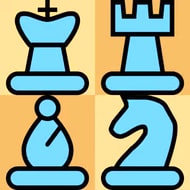
Chessformer looks like chess at a glance, with the same pieces and the same movement rules, but it plays like a sliding puzzle where every move is final and every wrong turn is obvious only after it’s too late to undo.
| Genre |
Puzzle Strategy |
| Main Focus |
Piece Movement Logic |
| Core Pieces |
Knight, Bishop, Rook, Queen, King |
| Platform |
Browser |
Moving Like a Chess Piece, Thinking Like a Puzzler
Each level in Chessformer hands you a single piece and a small grid, and the piece can only move the way it would on a real chessboard. A Bishop slides diagonally until it hits an edge or an obstacle; a Knight jumps in its familiar L-shape regardless of what sits between its start and end squares.
The puzzle comes from the fact that these movement rules don’t stop at the first square you’d normally want. A Rook can’t tap the brakes halfway across the board, so lining up a Rook’s path means planning several moves ahead, not just the next one.
Reading the Board Before the First Move
New players tend to move on instinct the way they might in a casual chess match, and Chessformer punishes that immediately. A single Knight jump can land you on the only square that blocks your path to the goal for the rest of the level.
Because each piece obeys its normal movement pattern without exception, most levels are solvable by working backward from the goal square, tracing which piece movements could land there, and checking whether the board layout actually permits that path.
Recognizing Which Piece Solves Which Puzzle
Later levels in Chessformer mix multiple piece types on the same grid, and part of the challenge is recognizing which piece’s movement pattern actually fits the puzzle in front of you before spending a move testing it. A Bishop-only path across a grid with obstacles on every diagonal is unsolvable no matter how carefully it’s planned, and noticing that early saves a wasted attempt.
Traps and blocked squares add another layer on top of pure movement logic, since a King’s single-square step or a Queen’s long, unobstructed lines interact very differently with the same obstacle layout, and levels are frequently built to highlight exactly that contrast.
Chessformer: Frequently Asked Questions
Why does my Rook keep sliding past the square I wanted?
Chess pieces in Chessformer move until they hit an obstacle or the board’s edge, so a Rook aimed at a mid-path square will overshoot unless something is placed to stop it exactly there.
Is there a way to undo a wrong move?
Most levels require restarting once a piece lands somewhere unrecoverable, which is why reading the full board layout before moving matters more than reacting move by move.
Why does the same piece feel different across levels?
Each level’s obstacle layout changes what a piece’s fixed movement pattern actually accomplishes, so a Knight that solves one grid easily can be nearly useless on a different layout despite following identical rules.
Chessformer takes a set of rules most players already half-know from chess and turns them into something stricter, where the challenge isn’t outmaneuvering an opponent but predicting exactly how far a single piece will travel before you’ve committed to the move.