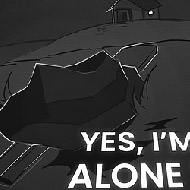
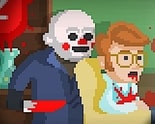
In Yes, I’m alone 2 you start already inside the aftermath of a choice made in the first game: you let the visitor in, and now the story is asking what it actually costs to keep living with him. There’s no fresh introduction to ease you into the horror here, because the premise assumes you already know who the Pale Guy is and why a locked door used to matter so much.
Continuing From the Ending of Yes, I’m Alone
The sequel picks up specifically from the “you joined the visitor” outcome of the first visual novel, which means players who reached a different ending in the original game are stepping into a scenario they never technically unlocked themselves. That choice doesn’t feel like a formality once the story gets moving; it reshapes the protagonist’s relationship to the Pale Guy from the opening scenes onward, framing him less as an intruder to be feared and more as something the player now has to adapt to living alongside.
What makes this framing unsettling rather than comforting is how the game refuses to soften the Pale Guy’s nature just because the door was opened willingly. He remains an unpredictable presence, and Yes, I’m alone 2 spends a significant amount of its runtime letting the player feel the tension of that arrangement rather than resolving it early.
Players coming in cold, without having finished the original, tend to lose track of why certain characters react to the protagonist’s decisions the way they do. The game doesn’t pause to re-explain the stakes established earlier, which is a deliberate choice that rewards series familiarity over accessibility.
The Pale Guy, the Homeowner, and the Rest of the Cast
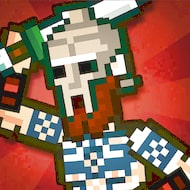
Character writing is where this visual novel gets the most attention from its community, and it’s easy to see why once you spend a few hours with the cast. The Pale Guy dominates most discussion threads, partly because of how many distinct endings revolve around him and partly because his behavior shifts noticeably depending on choices made hours earlier in the same playthrough.
The Homeowner gets quieter but no less committed praise, particularly for how his mental state is written across the story rather than stated outright. Players have described feeling real discomfort watching his arc unfold, which is a strong reaction for a character who spends comparatively little screen time compared to the Pale Guy.
Cat Lady and CoatGuy round out a supporting cast that could easily have felt like filler in a shorter game, but both accumulate enough small, specific moments across a full playthrough that longtime players single them out by name when discussing favorite scenes. That level of attachment to secondary characters is unusual for a fan-made project of this scope.
Nineteen Endings and the Weight of Small Decisions
Yes, I’m alone 2 ships with nineteen distinct endings: nine bad, seven good, two described by the community as “brutal,” and one hidden “???” ending that most players only find through trial and error or outside guidance. That’s already a lot of branching for a solo-developed visual novel, and the original plan reportedly called for even more before the scope was trimmed to keep the game a manageable size.
What stands out isn’t just the number of endings but how small the decisions leading to them can be. Choosing to hand over a camera at the right moment, or declining a request from the visitor before checking a specific room first, can quietly lock in an ending path long before the story signals that anything consequential just happened.
This is where the game earns comparisons to a puzzle box rather than a straightforward horror story. Community guides exist specifically because certain endings, like the one involving a hidden broken plate found only by exploring a bedroom’s adjoining room, are functionally undiscoverable without either exhaustive trial and error or someone else’s notes.
Art, Atmosphere, and What Playing Alone at Night Feels Like
The hand-drawn illustration work carries a huge amount of the horror’s weight, and the numbers back up how much effort went into it: over four hundred original pieces of art across the full game, all produced by a single artist. That density shows up in how often the story pauses to let a new image sit on screen rather than rushing forward through dialogue alone.
The unsettling quality of Yes, I’m alone 2 doesn’t come from jump scares stacked one after another. It leans instead on prolonged discomfort, the sense that a scene which looks ordinary is building toward something the player can’t quite name yet. Long stretches of quiet dialogue between the protagonist and the Pale Guy do more to unsettle experienced horror fans than any single scripted scare.
Sound design, built with lightweight tools rather than a full audio team, still manages to reinforce that atmosphere in ways players bring up constantly in comments and playthrough videos, particularly during the transformation-themed sequences late in the story.
What Beginners Get Wrong on a First Playthrough
New players consistently underestimate how much a single early choice can foreclose entire branches of the game later on. Rushing through the opening scenes to “get to the good part” is the most common regret reported in comment sections, because several of the more distinctive endings depend on decisions made before the story has clearly signaled their importance.
A second common mistake is treating the Pale Guy’s requests as simple binary choices with no lasting weight. Players who ignore small behavioral cues from him early on often find themselves confused later when the story references a pattern they didn’t realize they were building.
The gallery feature, unlocked as endings are collected, becomes a useful tool for players trying to fully understand the cast, since it displays character variants tied to specific outcomes that don’t appear anywhere else in a single playthrough.
Divisive Elements the Community Still Argues Over
Not everything about Yes, I’m alone 2 lands cleanly with every player. The reliance on prior knowledge of the first game is a recurring point of friction, and some newcomers feel locked out of context that longtime fans take for granted. Others argue this exclusivity is intentional and part of what gives the sequel its weight.
The sheer density of endings also splits opinion. Some players love the completionist chase and treat the nineteen outcomes as the entire point of returning to the game, while others find the amount of blind trial and error required to find certain paths frustrating rather than rewarding, especially without outside guides.
Common Questions About Yes, I’m Alone 2
- How do you get the hidden “???” ending? It requires a very specific combination of choices tied closely to how the protagonist treats the Pale Guy across the full story, and most players only reach it after consulting a guide once they’ve already collected several of the other eighteen endings.
- Do you need to play the first Yes, I’m alone before this one? The story assumes familiarity with the original game’s “joined the visitor” ending, and the sequel does not stop to re-explain who the Pale Guy is or why the protagonist’s earlier choice matters.
- Is Yes, I’m alone 2 connected to No, I’m Not a Human? It’s built as a fan work inspired by that game’s characters and setting, using original art, writing, and music, but it isn’t treated as canon to the original title it draws from.
Whether you land on one of the seven good endings or find yourself staring at the “???” screen after hours of quiet dread, Yes, I’m alone 2 keeps circling back to the same question the Pale Guy poses long before the credits roll: once you’ve let something like him inside, how much of yourself are you willing to let him change.